
Ever poured your heart into creating the perfect website, packed with helpful content, only to find it’s nowhere to be seen on Google? You’re not alone. Many business owners and marketers face this frustrating reality, and the culprit is often an incomplete SEO strategy.
The truth is, SEO isn’t a single, magical trick. It’s a trio of powerful disciplines working in concert. If your website isn’t ranking despite great content, one of these three pillars might be missing.
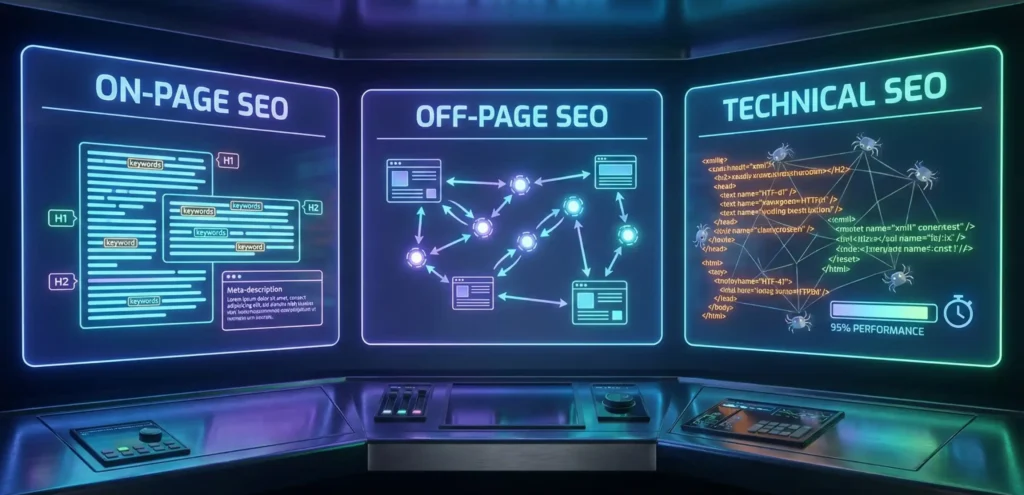
In this complete guide, we’ll break down the three core types of SEO—On-Page, Off-Page, and Technical—so you can understand what each one does and how they work together to drive real, sustainable results.
1. Understanding On-Page SEO: The Foundation of Optimization
What is On-Page SEO?
Think of On-Page SEO as all the optimization you do on your own website. It’s about sending clear signals to both search engines and users that your page is the best answer to their query. If your website were a physical store, On-Page SEO would be your window display, your organized shelves, and your friendly staff.
Key Elements of On-Page SEO
- Keyword Optimization: This is about using relevant words and phrases (keywords) that people are searching for. The key here is natural integration. Gone are the days of “keyword stuffing.” Use your primary keyword in critical places like the title, headings, and introduction, but write for humans first.
- Content Quality: Google’s main goal is to serve up helpful, reliable information. Your content must be engaging, thoroughly answer the user’s question, and provide unique value. Comprehensive, well-written content builds authority and keeps people on your page longer.
- Internal Linking: This is like building pathways between the pages of your own website. By linking to other relevant pages on your site, you help users navigate, spread “link equity” (ranking power), and show Google how your content is organized. It’s a powerful way to highlight your most important pages.
- Meta Tags & Headings: These are the signposts for your content.
- Title Tag: This is the blue clickable link in search results. Make it compelling and include your primary keyword.
- Meta Description: This is the short blurb under the title. While not a direct ranking factor, it influences click-through rates.
- H1 Tag: This is the main headline of your page. You should only have one H1, and it should clearly state the page’s topic.
Pro Tip: High-quality content increases “dwell time” (how long a user stays on your page after clicking from search results). Google sees this as a positive signal that your page is satisfying the user’s intent.
2. Off-Page SEO: Building Your Website’s Reputation
What is Off-Page SEO?
If On-Page SEO is what you do on your site, Off-Page SEO is everything that happens off your site that influences your rankings. It’s essentially your website’s reputation. Google looks at these external signals to determine how trustworthy, authoritative, and popular your site is.
Key Elements of Off-Page SEO
- Backlinks: This is the cornerstone of Off-Page SEO. A backlink is when another website links to yours. Think of it as a vote of confidence. Not all votes are equal, though; a link from a well-respected, high-authority site in your industry is far more powerful than dozens of links from low-quality directories. Quality always trumps quantity.
- Brand Mentions & Social Signals: Even if a website mentions your brand without a direct link, it still counts as a signal of growing popularity. Social media shares, while not a direct ranking factor, increase your content’s visibility, which can lead to more natural backlinks.
- Content Marketing: This is a primary strategy for earning those valuable backlinks. By creating exceptional content like guest posts for other blogs, infographics, or original research, you provide value that others naturally want to reference and link to.
Pro Tip: Avoid “black hat” tactics like buying links. Google’s algorithms are sophisticated and can penalize sites that try to manipulate rankings. Focus on earning links naturally through creating remarkable content and building genuine relationships.
3. Technical SEO: Powering Your Website Behind the Scenes
What is Technical SEO?
Technical SEO is the work you do to ensure your website meets the technical requirements of modern search engines. It’s the behind-the-scenes foundation. You can have the best content and a great reputation, but if search engines can’t efficiently crawl and understand your site, you’ll struggle to rank.
Essential Technical SEO Factors
- Website Speed Optimization: A slow-loading site creates a poor user experience and hurts your rankings. Google prioritizes fast sites. Tools like Google PageSpeed Insights can help you identify and fix speed issues.
- Mobile-Friendly Design: With most searches now happening on mobile, your site must look and work perfectly on all devices. This is non-negotiable.
- Site Architecture & Crawl Budget: Your site should be logically structured (a clean site architecture) so that both users and search engines can find what they need in just a few clicks. A messy site wastes your crawl budget, which is the number of pages Googlebot can and wants to crawl on your site.
- Index Coverage & XML Sitemaps: You need to ensure Google has found and indexed your important pages. An XML sitemap is a file that lists all your crucial pages, acting as a roadmap for search engines to ensure nothing gets missed.
- Canonical Tags & Structured Data: Canonical tags are used to tell search engines which version of a page is the “master” copy, solving duplicate content issues. Structured data (or schema markup) is a code you add to your site to help search engines understand the context of your content (e.g., that a recipe has a 5-star rating and cooking time), which can lead to enhanced search results.
Pro Tip: Implementing schema markup doesn’t just help Google understand your page; it can also generate rich snippets in search results, which dramatically improve your click-through rate (CTR).
4. How On-Page, Off-Page, and Technical SEO Work Together
These three pillars are not isolated silos; they are deeply interconnected. A successful SEO strategy requires harmony between them.
- On-Page SEO creates the valuable, keyword-rich content that is worth linking to.
- Off-Page SEO builds the authority and trust that tells Google your content is credible, boosting the rankings of your well-optimized pages.
- Technical SEO provides the solid foundation, ensuring that your great content can be found, crawled, and indexed efficiently.
A Simple Analogy: Think of SEO as a high-performance car.
- Technical SEO is the engine, chassis, and wheels—the functional framework.
- On-Page SEO is the high-quality fuel and the skilled driver.
- Off-Page SEO is the social proof and reputation that makes everyone recommend this car over others.
You need all three parts to win the race.
5. Common SEO Mistakes to Avoid
- Focusing on Only One Pillar: Pouring all your effort into building backlinks while ignoring a slow, technically broken site is a recipe for failure.
- Keyword Stuffing: Forcing keywords into your content makes it unreadable and will be penalized by Google.
- Neglecting Crawl Errors: Ignoring 404 errors, broken links, and indexation issues means your best pages might never be seen.
- Poor Internal Linking: Having a “flat” site structure where pages are isolated makes it hard for link equity to flow and for users to discover related content.
6. Final Thoughts: Building a Balanced SEO Strategy
Climbing the search rankings isn’t about finding one secret trick. It’s about building a balanced, holistic strategy that integrates On-Page, Off-Page, and Technical SEO.
A great first step is to perform a quick audit of your own website. Check your page speeds, look for broken links, analyze your top competitors’ backlinks, and review your content’s quality and keyword usage.
Whether you’re a business owner or a digital marketer, mastering these three SEO types is your roadmap to better rankings. By giving each pillar the attention it deserves, you’ll build a website that is not only found but also trusted and adored by your audience.